A small flower works well on the pocket or cuff of the slow-stitch jacket. Draw a coin-sized circle and mark five loose petal shapes around it. Use the mark as direction, not as a line that must be completely covered.
Work from the centre outward
- Attach a small round fabric scrap with short running stitches, or fill the centre with cross-stitches.
- Form five petals with detached chain stitch or two rows of running stitch that meet at the point.
- Add a short stem and two leaves; keep some jacket fabric visible between the stitches.
- Repeat one colour in three places so that the motif feels connected.
Let simple stitches do the work
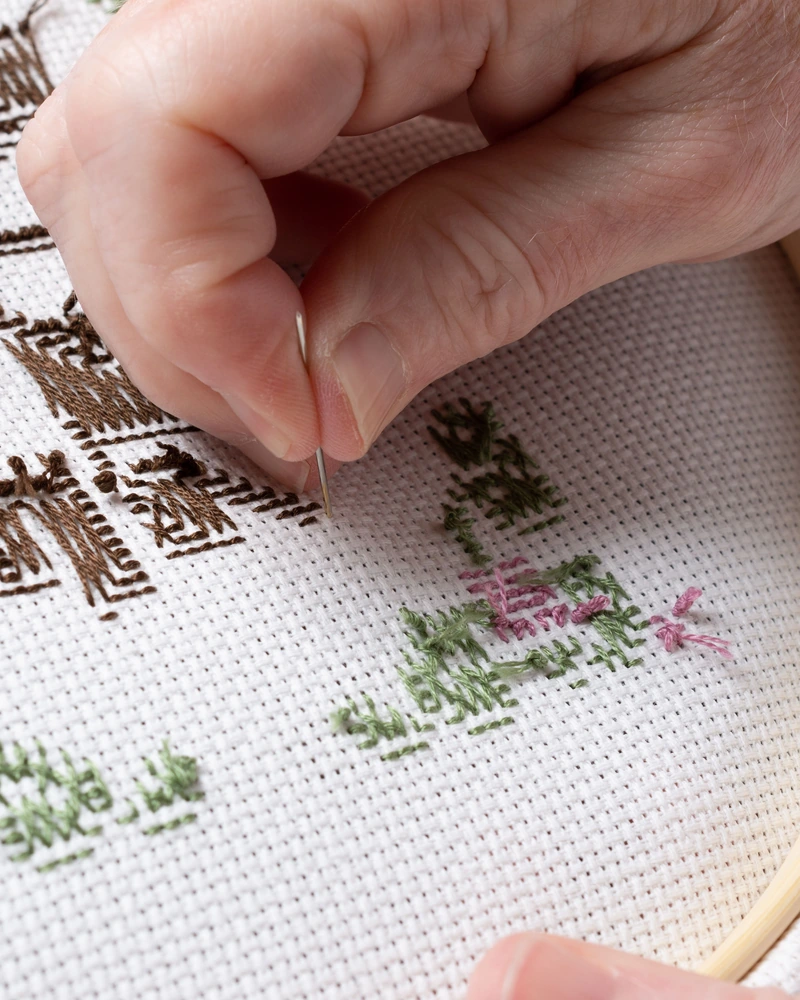
DMC’s step-by-step stitch diagrams are useful when you want to review running, back or detached chain stitch. Practise each new stitch three times on an offcut, then use the same hand rhythm on the jacket.
Before the first stitch
- The jacket is washed, dry and pressed smooth.
- The motif does not disappear beneath an arm or fold when you wear the jacket.
- Fabric pieces are secured with tacking stitches or small safety pins.
- The back of the work remains accessible.
Frequently asked questions
How large should a first flower be?
About 5–8 cm is easy to control and large enough for clear detail.
May I change the design while working?
Yes. Take a photograph after every colour and add another leaf or stitch row only when the motif genuinely looks empty.