Complete preparation guide
Choose text size
Change the article text to large, larger or largest.
01
Competition requirements
- Work on stretched canvas or a suitable rigid painting surface.
- The final size is A3, including any necessary mounting.
- No frame or glass may be used.
- Only brush technique is allowed.
- Use good-quality acrylic paint.
- The work may not be older than two years and must be initialled and dated.
- The scene and design must be the entrant’s own original work.
02
Composition and subject
Choose a scene with a clear focal point and avoid unnecessary detail. Buildings or figures may form part of the landscape, but should not become the main subject. Take care with sunsets in which almost everything appears only as silhouettes; the landscape must still show form, tone and depth.
03
Preparation and paint handling
- Prepare the surface with an even layer of gesso.
- Make a small composition sketch and a light-and-dark study beforehand.
- Round, flat and filbert brushes may be used according to the desired mark.
- Build the painting in layers and work mainly from dark to light.
- Remember that many acrylic colours appear darker after drying.
- A retarder or blending medium may be used when a longer working time is needed.
- Check the lightfastness and permanence of the paint.
- A suitable varnish or sealer may be applied only when the work is completely dry.
04
Practical working sequence
- Determine the horizon line and focal point.
- Block in the largest light and dark shapes.
- Create depth through scale, overlap, tone and colour temperature.
- Develop the foreground with stronger contrast and more texture.
- Keep the background calmer and less detailed.
- Add only the details that strengthen the composition.
- Allow the work to dry completely and clean the edges.
05
What the judging focuses on
Appearance counts 60% and workmanship 40%. The judge considers composition, originality, focal point, perspective, tonal values, colour harmony, brush control, handling of materials and the finished impression of the painting.
06
Presentation
Protect the dry painting in a bubble-wrap bag. Do not seal the bag with adhesive tape. Label it PAINTING, followed by the entrant’s name, branch, region and province. Attach the judging card to the back of the work with adhesive tape and a sufficiently long piece of crochet thread.
07
Final checklist
- A3, including mounting
- No frame or glass
- Brush technique only
- Original scene
- Initialled, dated and not older than two years
- Completely dry and safely packed
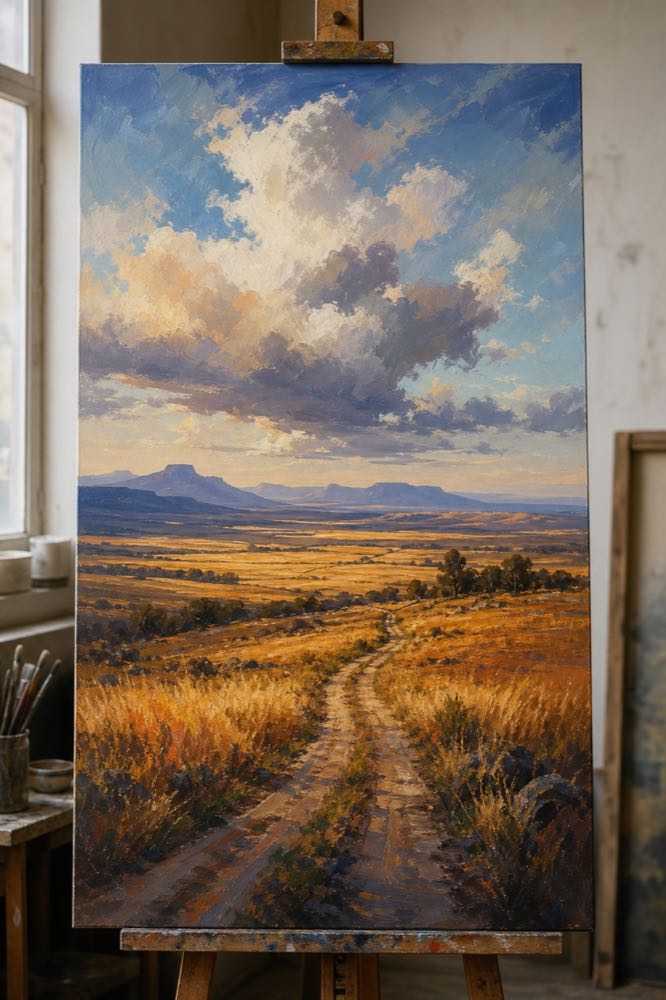
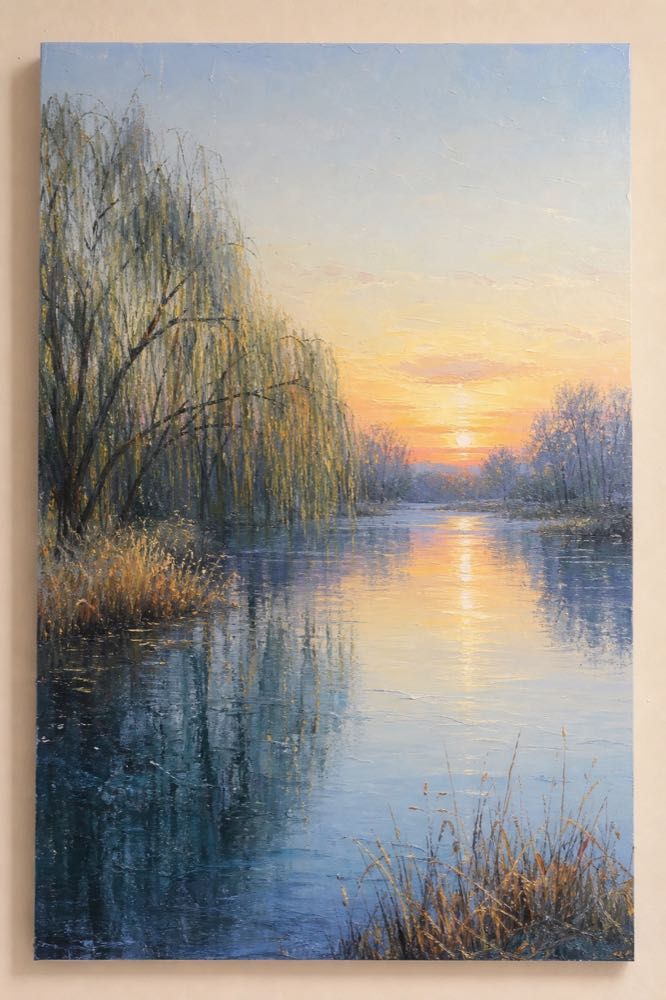
Two portrait-format examples
Painting
Use these original examples as inspiration for layout, colour and presentation—not as patterns to copy exactly.