Complete preparation guide
Choose text size
Change the article text to large, larger or largest.
01
Competition requirements
- The gilet must be hip-length and sleeveless.
- The design must show a creative, original and innovative approach.
- The entry may not be older than two years.
- Any yarn weight, fibre, pattern stitch, stitch combination and colour variation may be used.
02
Fit and construction
A gilet is worn over another garment. The neckline should therefore not be so high or tight that it sits uncomfortably over a blouse or top. Any suitable neckline shape may be used.
Slits in the side seams are allowed. When the front and back pieces are joined only at the shoulders, a suitable closure or fastening must be provided at the sides. Shoulder lines, armholes, neckline and lower edge must retain their shape and be finished cleanly.
03
Creative use of materials
Stripes, irregular blocks, a “crazy patchwork” approach, colour fields and different textures may be used. Limit the number of effects, however, so the gilet does not look confused or heavy. Embellishments and embroidery may be added sparingly, but the knitting must remain the main feature.
04
Tension and sampling
Different yarns and pattern stitches do not always behave in the same way. Make test swatches of every combination beforehand. Wash or treat the swatches as the final gilet will be treated and measure them again after drying. Adjust needle sizes to maintain consistent, neat tension.
05
Working sequence
- Determine the final length, width, neckline and side finish.
- Draw a simple sketch of the colour and texture distribution.
- Make and measure swatches for all the main stitch and yarn combinations.
- Calculate the panels or shaped pieces and keep the total weight of the gilet in mind.
- Try it on regularly during the knitting process.
- Finish all seams flat and neatly.
- Block the completed gilet according to the fibres used.
06
What the judging focuses on
Appearance counts 50% and workmanship 50%. The gilet must make a strong creative impression without sacrificing wearability. Even tension, good fit, purposeful use of colour, technical finishing and a coherent design are essential.
07
Presentation
Place the gilet in a transparent plastic bag and label it KNITTING, followed by the entrant’s name, branch, region and province. Attach the judging card to the entry with crochet thread. Do not use a safety pin.
08
Final checklist
- Hip-length and sleeveless
- Creative, wearable and not older than two years
- Neckline suitable for a garment underneath
- Sides joined correctly or provided with fastenings
- Even tension despite different yarns or stitches
- Embellishments do not dominate the knitting
- Correctly packed and labelled
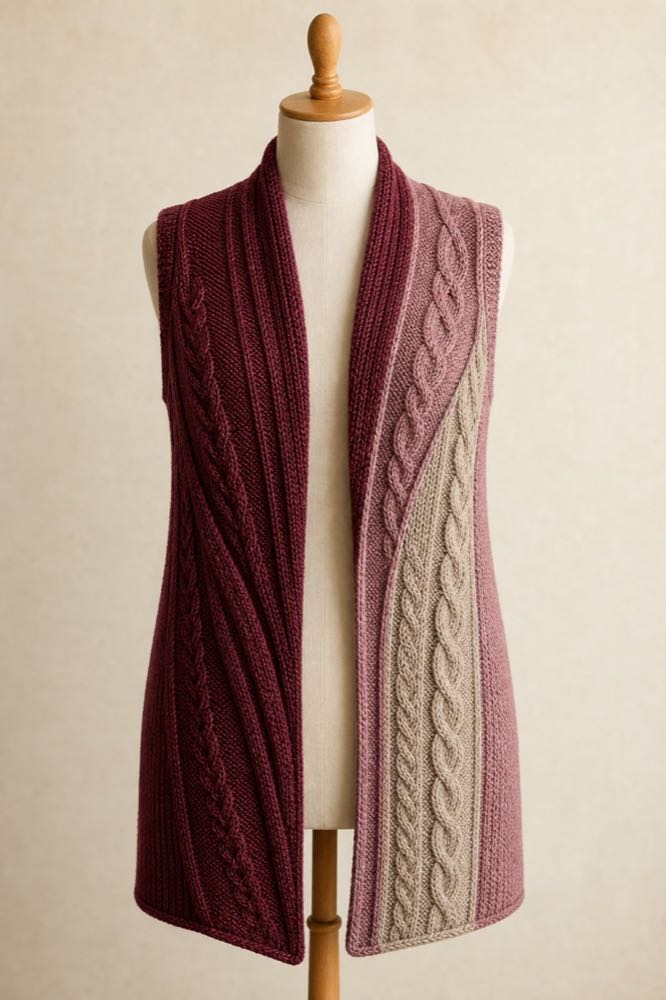
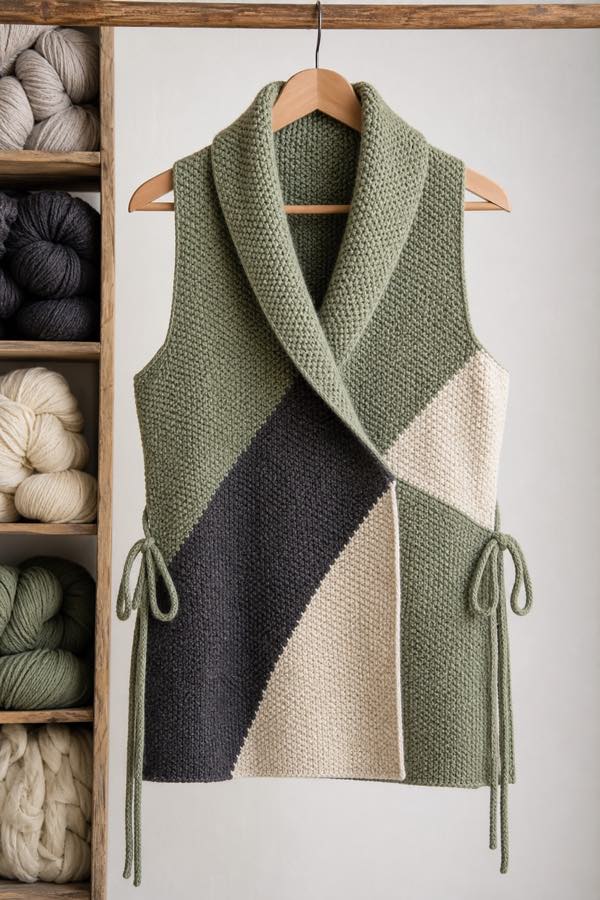
Two portrait-format examples
Knitting
Use these original examples as inspiration for layout, colour and presentation—not as patterns to copy exactly.