Complete preparation guide
Choose text size
Change the article text to large, larger or largest.
01
Competition requirements
- The completed entry may not be older than two years and must be initialled and dated.
- At least two different forms of counted-thread embroidery must be used.
- The techniques must be clearly distinguishable from one another.
- The two or more techniques do not have to occupy equal space in the design.
- A wall hanging may be mounted, provided the mounting is protected with adhesive plastic. A frame or glass is not allowed.
- Large, cumbersome entries should be avoided.
- An unfinished entry will not be accepted.
02
Planning the embroidery
Any suitable form or combination of counted-thread embroidery may be used. Each technique must, however, be worked correctly according to its own method. Choose a pattern in which the two techniques form a coherent whole rather than looking like separate samples placed next to each other.
03
Fabric and thread
A durable evenweave linen or cotton is a good choice. Evenweave means that the number of threads per square centimetre corresponds in both directions. Aida and Hardanger fabric are not recommended for this entry. The chosen embroidery techniques will determine which type and thickness of thread work best.
04
Practical working method
- Mark the centre of the fabric and the centre of the design.
- Stretch the fabric in a frame to keep the tension even.
- Work a small test section when combining different threads or stitch types.
- Work systematically and check the count regularly.
- Keep the stitch direction consistent and avoid long, loose carries on the back.
- Finish starting and ending points unobtrusively.
- Block the completed work square and allow it to dry completely before packing it.
05
What the judging focuses on
Appearance counts 60% and workmanship 40%. Pay particular attention to symmetry, accurate counting, recognisable techniques, even tension, effective use of colour, neat finishing and a back without loose threads or knots that affect the front.
06
Presentation
Place the entry in a transparent plastic bag and label it HAND EMBROIDERY, followed by the entrant’s name, branch, region and province. Attach the judging card to the work with crochet thread. Do not use a safety pin.
07
Final checklist
- Two or more recognisable counted-thread techniques
- Completed, initialled and dated
- Not older than two years
- Evenweave linen or cotton used correctly
- Even tension and error-free counting
- No frame or glass
- Correctly packed and labelled
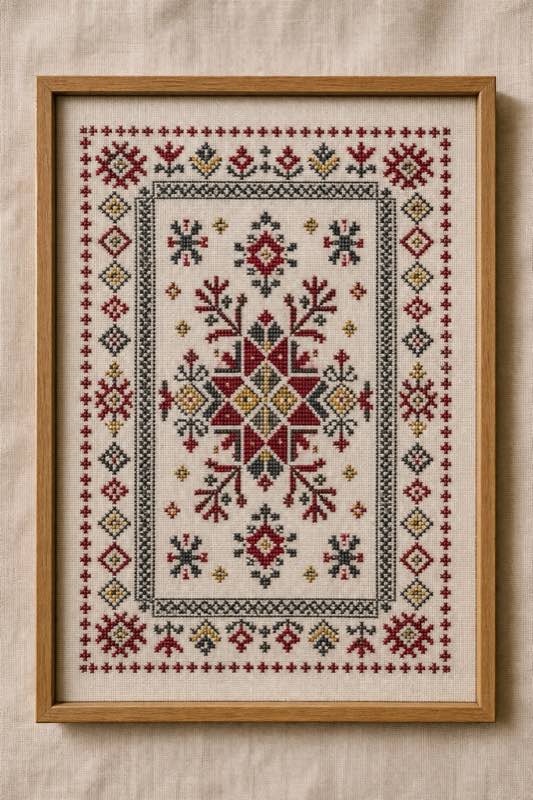
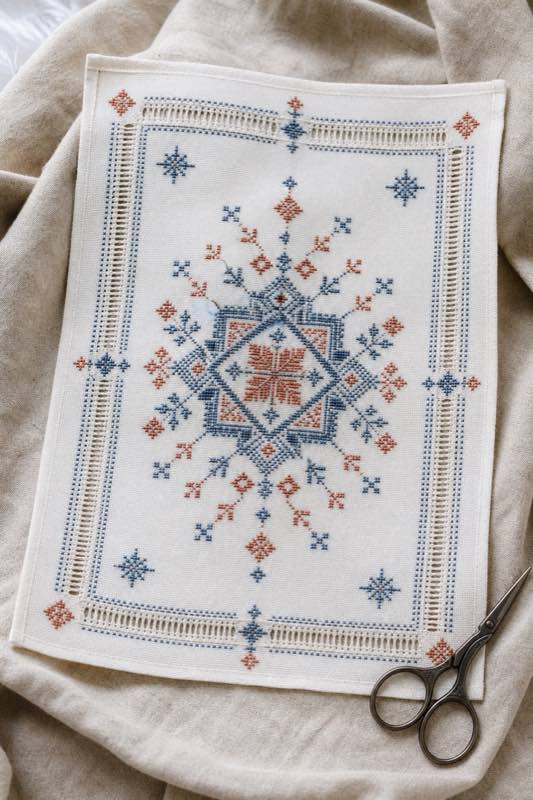
Two portrait-format examples
Hand Embroidery
Use these original examples as inspiration for layout, colour and presentation—not as patterns to copy exactly.